0 Comments
20Oct 2026

HEART
HEART
Khartoum, Sudan | October 2026
The Humanitarian Empowerment and Relief Team (HEART) highlights the alarming findings of Sudan’s Multidimensional Poverty Survey 2023, released in July 2026 by the Central Bureau of Statistics (CBS), in collaboration with the United Nations Development Programme (UNDP) and the Oxford Poverty and Human Development Initiative (OPHI).
The findings reveal the scale of deprivation affecting Sudanese communities and underscore the urgent need for coordinated humanitarian assistance, early recovery interventions, and sustainable development efforts.
According to the survey:
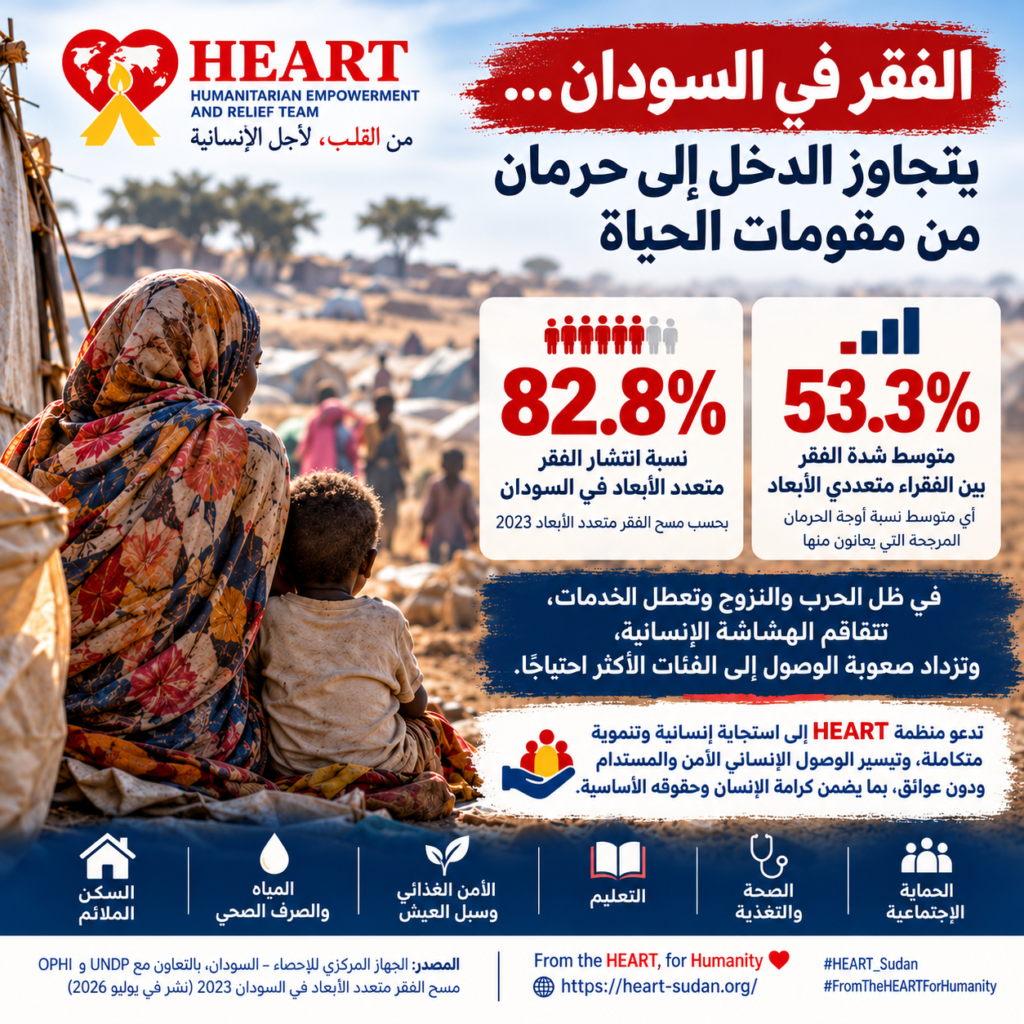
🔴 82.8% – Multidimensional Poverty Incidence: Approximately eight out of every ten people in Sudan experience overlapping forms of deprivation.
🔴 53.3% – Average Poverty Intensity: People identified as multidimensionally poor experience, on average, 53.3% of the weighted deprivations measured by the index.
🔴 0.441 – National Multidimensional Poverty Index (MPI): A measure reflecting both the prevalence and intensity of multidimensional poverty.
These findings demonstrate that poverty extends far beyond insufficient income. It encompasses interconnected disadvantages affecting access to healthcare, education, essential services, adequate living conditions, and opportunities for sustainable livelihoods.
Importantly, these figures are based on the 2023 survey and should not be interpreted as an updated assessment of the full humanitarian and socioeconomic consequences of the conflict through 2026.
Sudan’s ongoing armed conflict has further intensified an already challenging humanitarian situation.
Widespread displacement, loss of livelihoods, damage to essential infrastructure, disruption of agricultural production, and the deterioration of basic public services have increased the vulnerability of communities across the country.
For many Sudanese families, the consequences extend beyond the immediate loss of income and assets. They include growing difficulties in accessing food, safe drinking water, healthcare, education, and adequate shelter.
At the same time, the conflict has complicated humanitarian response operations.
Ongoing hostilities, insecurity along transportation routes, damaged infrastructure, administrative constraints, logistical challenges, and funding shortages continue to affect the ability of humanitarian organizations to reach vulnerable populations safely, consistently, and effectively.
Consequently, affected communities face two interconnected challenges: increasing humanitarian needs and persistent difficulties in accessing essential assistance and services.
Addressing these challenges requires sustained humanitarian engagement, improved operational access, and coordinated efforts to strengthen community resilience.
The Humanitarian Empowerment and Relief Team (HEART) emphasizes that addressing multidimensional poverty in Sudan requires an integrated approach that goes beyond immediate humanitarian relief.
While emergency assistance remains essential for saving lives, sustainable recovery also depends on restoring basic services, protecting livelihoods, and strengthening the ability of communities to rebuild their futures.
HEART calls for coordinated action across the following priorities:
🌾 Food Security and Livelihoods: Strengthening food assistance, supporting local agricultural production, and helping conflict-affected households restore sustainable sources of income.
🏥 Health and Nutrition: Improving equitable access to essential healthcare, nutrition services, and community-based health interventions.
📚 Education: Supporting access to education and protecting children from prolonged learning disruptions and educational exclusion.
💧 Water, Sanitation and Hygiene (WASH): Expanding access to safe drinking water, adequate sanitation facilities, and essential hygiene services.
🤝 Protection and Social Inclusion: Strengthening protection mechanisms and supporting women, children, young people, persons with disabilities, and other vulnerable groups.
🏘️ Early Recovery and Community Resilience: Supporting the rehabilitation of essential infrastructure and helping displaced and conflict-affected communities restore stability and basic services.
🕊️ Humanitarian Access and Civilian Protection: Promoting safe, sustained, and unhindered humanitarian access while advocating for the protection of civilians and humanitarian personnel.
HEART reaffirms its commitment to the four fundamental humanitarian principles:
Humanity | Neutrality | Impartiality | Independence
Humanitarian assistance must be guided by assessed needs and delivered without discrimination, regardless of political affiliation, geographical location, or other considerations unrelated to humanitarian vulnerability.
The organization emphasizes that protecting civilians, facilitating humanitarian access, and ensuring assistance reaches those most in need are essential responsibilities in any humanitarian response.
Humanitarian neutrality does not mean remaining silent about human suffering. It means responding to that suffering impartially, independently, and without taking sides in hostilities or political controversies.
Multidimensional poverty is more than a statistical indicator.
It represents children whose education has been interrupted, families struggling to secure sufficient food, patients unable to access essential healthcare, and communities deprived of the services and opportunities necessary for a dignified life.
In Sudan, the combined challenges of poverty, armed conflict, displacement, and restricted humanitarian access demand a response that connects immediate lifesaving assistance with longer-term recovery and development.
Sudan needs more than emergency relief. It needs sustained efforts to protect human dignity, restore essential services, rebuild livelihoods, and create the conditions for inclusive and sustainable recovery.
HEART remains committed to promoting evidence-based humanitarian action, community resilience, and people-centered approaches that place human dignity and humanitarian needs at the heart of the response.
Source: Central Bureau of Statistics (Sudan), in collaboration with the United Nations Development Programme (UNDP) and the Oxford Poverty and Human Development Initiative (OPHI).
Report: Multidimensional Poverty Survey 2023 – Sudan Report
Publication: July 2026
Official report:
Methodological clarification: The reported multidimensional poverty incidence of 82.8%, average poverty intensity of 53.3%, and MPI value of 0.441 refer to the survey’s 2023 reference period. They do not constitute a current measurement of poverty levels in October 2026 or quantify the additional impact of the ongoing conflict.
Humanitarian Empowerment and Relief Team (HEART)
🌐 Official Website: https://heart-sudan.org/
#Sudan #MultidimensionalPoverty #HumanitarianAccess #FoodSecurity #EarlyRecovery #HumanitarianResponse #HEART_Sudan #FromTheHEARTForHumanity